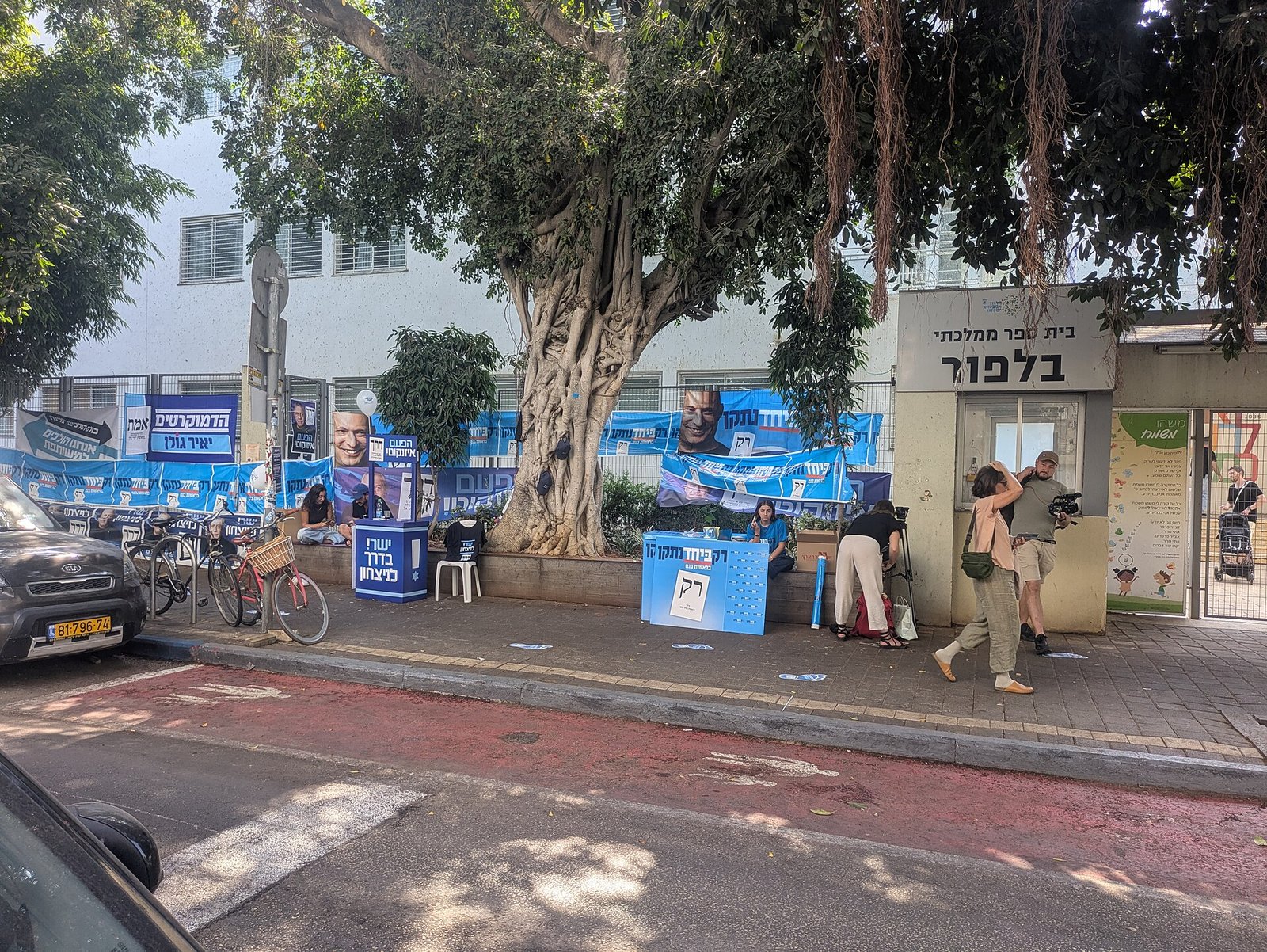
Photo: Nizzan Cohen / Wikimedia Commons, CC BY 4.0
Israel’s general election appears to have ended in deadlock. Exit polls released by the country’s three main television channels after voting closed at 10pm local time on Tuesday, October 27, showed neither Prime Minister Benjamin Netanyahu’s alliance nor the opposition bloc led by former army chief Gadi Eisenkot reaching the 61 seats needed for a majority in the 120-member Knesset.
The projections gave Eisenkot’s camp 52 or 53 seats against 50 for the parties backing Netanyahu. Arab-led parties, which sit outside both blocs, were projected to win 17 or 18 seats between them, which could make them decisive in the bargaining ahead. Exit polls can be wrong, and preliminary counts may shift the picture.
How the seats are projected to split
Netanyahu’s Likud is still expected to be the single largest party, but with only 24 or 25 seats, down from the 32 it won in 2022. Its partners were each projected in single digits:
- Pro-Netanyahu camp: Likud 24-25, Shas 6-8, Otzma Yehudit 6-7, United Torah Judaism 6-7, Religious Zionism 6
- Opposition camp: Eisenkot’s Yashar 21-23, Naftali Bennett’s Beyahad 12-14, Yair Golan’s Democrats 9-10, Avigdor Lieberman’s Yisrael Beiteinu 7-9
- Arab-led parties: Joint List 10-11, Ra’am 7
Eisenkot’s alliance is itself a mix of centrist, left-wing and right-wing parties, which will make it harder to hold together even if it finishes ahead.
Rival camps claim the moment
Eisenkot said the early figures pointed to a complete lack of confidence in Netanyahu and what he called the October 7 government. Opposition leader Yair Lapid described the result as a “crushing defeat” for the Netanyahu bloc, while Golan said voters had “fired” the government.
Foreign Minister Gideon Saar, a Likud member, said the celebrations were premature and pointed out that Likud remained the country’s largest party. Netanyahu, 77, has been prime minister for nearly 19 of the past 30 years and has come through several earlier inconclusive elections.
Record turnout and the Arab vote
The Central Elections Committee put turnout at about 77.7 per cent, or more than 56.9 lakh of roughly 73.3 lakh eligible voters. That is about seven points higher than in 2022 and the highest for a Knesset election since 1999. Earlier in the day the committee turned down a Likud request to keep polling stations open longer.
Turnout among Palestinian citizens of Israel rose sharply from about 53 per cent in 2022, and supporters celebrated in several Arab towns as the projections came in. Joint List leader Yousef Jabareen called it a historic day, and Ra’am leader Mansour Abbas said his party would turn its mandate into a “new reality”. Both Netanyahu and Eisenkot have ruled out a formal partnership with the Arab-led parties, but Ra’am and the Joint List have said they are open to supporting the opposition camp.
Why it matters and what comes next
This was Israel’s first national vote since the Hamas-led attack of October 7, 2023, and it was widely seen as a verdict on Netanyahu’s handling of that attack and the wars that followed in Gaza, Lebanon and with Iran. Parties must cross a 3.25 per cent threshold to win seats, so final numbers could change as votes are counted. If no side can build a 61-seat coalition, Netanyahu would stay on as caretaker prime minister while negotiations continue, and Israel could face a prolonged period of political uncertainty.