Photo: Lula Oficial / Wikimedia Commons, CC BY-SA 4.0
Brazilians began voting on Sunday in a presidential runoff that polls suggest is too close to call, with left-wing President Luiz Inácio Lula da Silva, 80, trying to win a fourth non-consecutive term against right-wing Senator Flávio Bolsonaro, 45. Polling stations opened at 8 am local time (4:30 pm IST) and close at 5 pm (1:30 am IST on Monday), with nearly 160 million people eligible to vote.
A narrow first round and tighter polls
Bolsonaro, the son of former president Jair Bolsonaro, finished ahead in the first round on October 4. According to the country’s electoral court, he took 47.03% of valid votes, about 5.61 crore ballots, against Lula’s 45.16%, or roughly 5.39 crore. Brazilian media described it as the smallest first-round gap between two candidates since the country returned to democracy in the 1980s. About 33 million voters stayed away from that round.
No candidate who trailed after the first round has ever gone on to win a Brazilian runoff. The final surveys keep the contest within the margin of error: Datafolha’s last poll, taken on October 23 and 24, put Bolsonaro on 51% of valid votes and Lula on 49%, and a compilation of 18 recent national polls by the outlet Poder360 found Bolsonaro numerically ahead in 17 of them.
Two very different pitches
Bolsonaro has campaigned on a hard line against organised crime, along with tax and public spending cuts, and argues that working with the United States against powerful criminal gangs would help the state retake areas they control. He has repeatedly reminded voters of the corruption scandals that hit Lula’s Workers’ Party, and has promised to free his father, who is serving a 27-year sentence for plotting a coup after losing the 2022 election and is currently held under house arrest because of poor health. He held his final rally in Belo Horizonte, capital of Minas Gerais, long seen as a must-win state for presidential hopefuls.
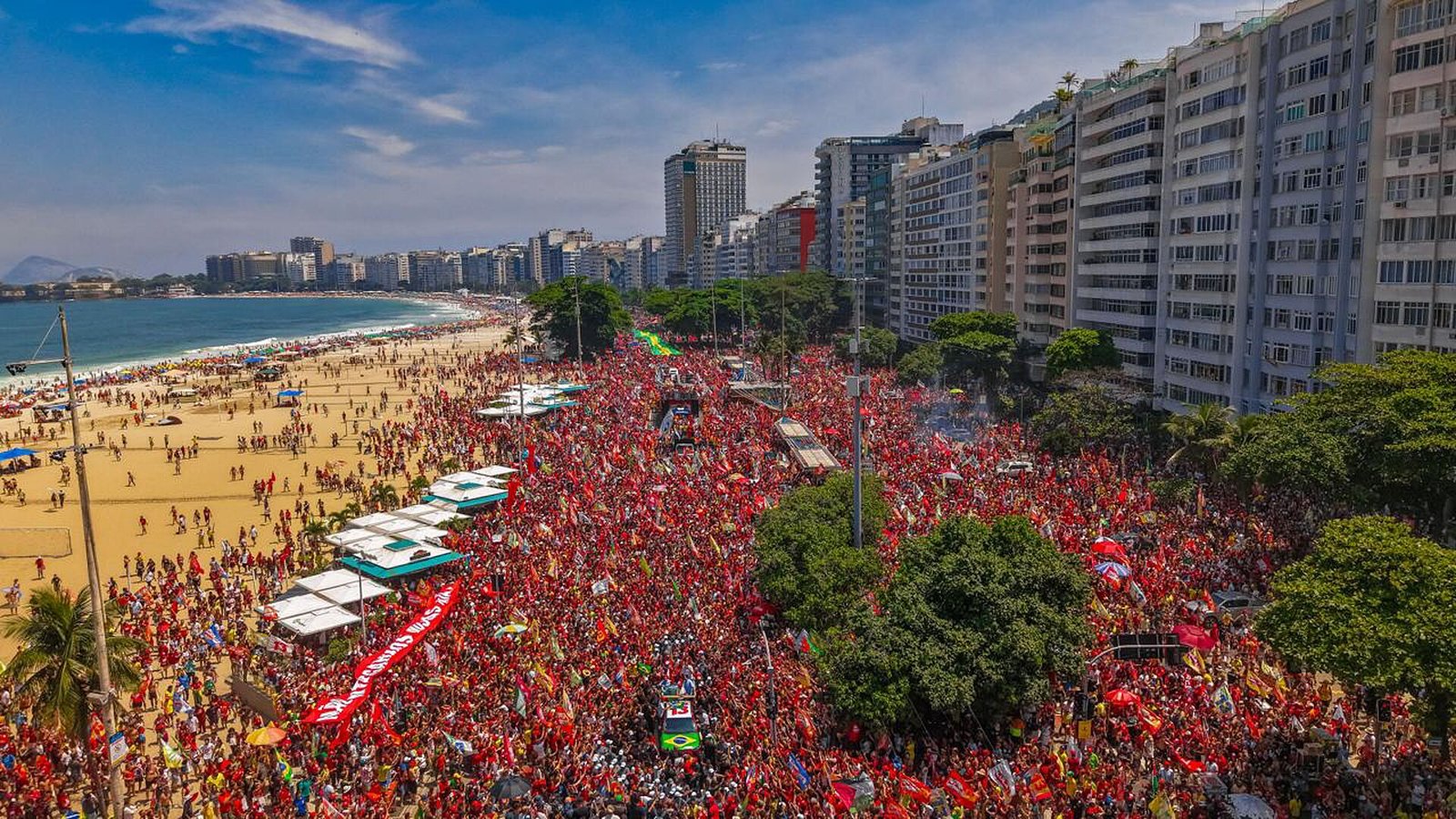
Lula’s camp has framed the vote as a fight to protect democracy, pointing to the elder Bolsonaro’s conviction. At a huge rally on Rio de Janeiro’s Copacabana beach on Saturday, Lula called the election a question of sovereignty and told supporters that voters wanted change but did not want to go backwards.
They don’t want to go backward.
Lula da Silva, at his Copacabana rally
Why it matters beyond Brazil
The United States has hung over the race. US President Donald Trump called Bolsonaro’s first-round lead a “very big” victory, Lula’s government has accused Washington of interfering in the election, and the US has rejected that charge as baseless. A Bolsonaro win would pull Latin America’s largest economy closer to Washington, while a Lula victory would extend a government that has repeatedly clashed with the Trump administration.
What happens next
Votes are cast on electronic machines, which election workers set up and tested on Saturday, and counting begins as soon as polls close. Lula plans to follow the count in São Paulo, while Bolsonaro will be in Brasília, where his father is under house arrest. The winner takes office on January 1.