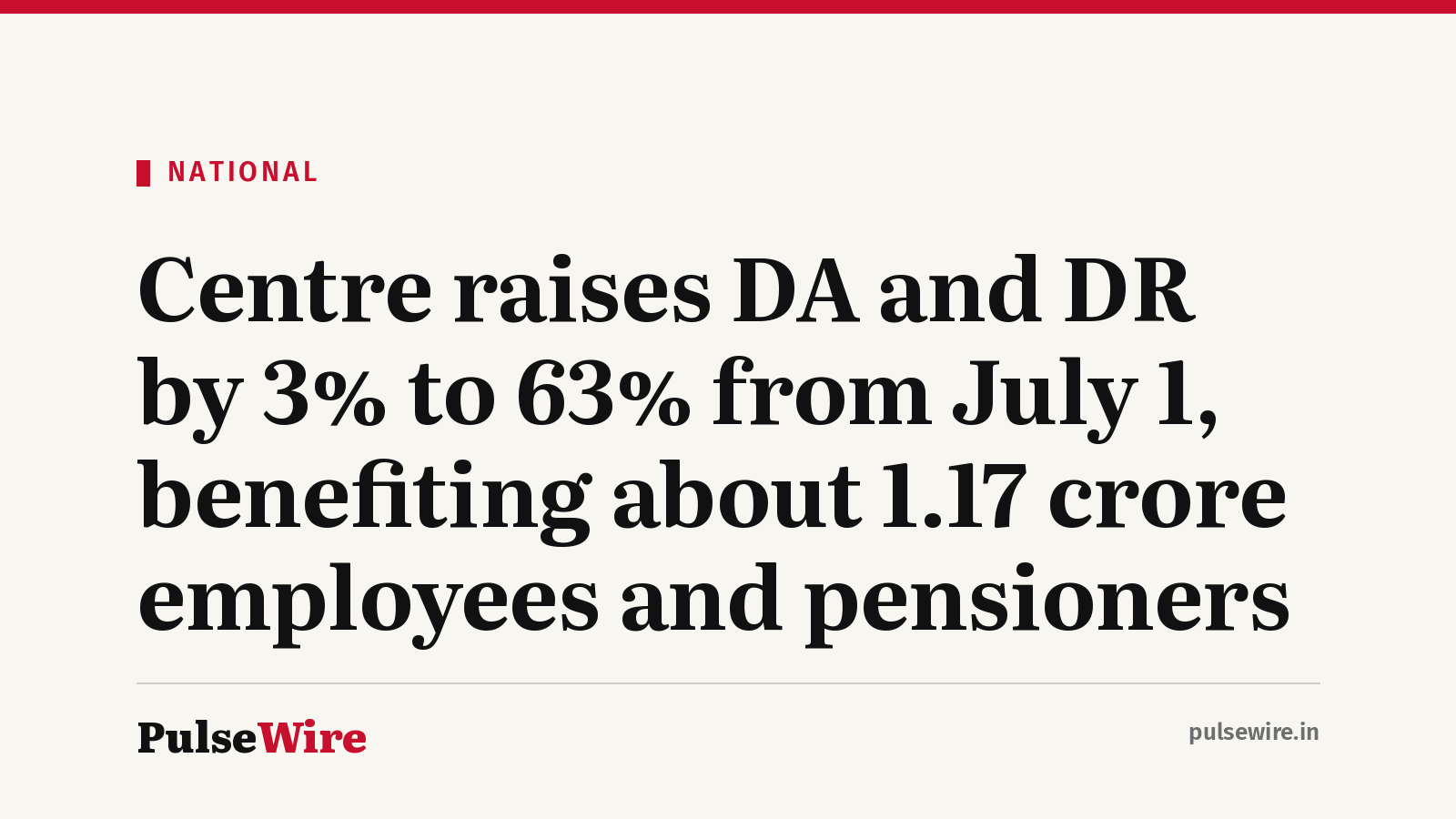
Central government employees and pensioners will get a 3 percentage point rise in dearness allowance (DA) and dearness relief (DR), after the Union Cabinet chaired by Prime Minister Narendra Modi approved a fresh instalment on Wednesday, October 28. The increase takes DA and DR from 60% to 63% of basic pay and basic pension, and applies retrospectively from July 1, 2026.
Who benefits and what it costs
According to the government, the decision covers about 48.54 lakh serving central government employees and 68.71 lakh pensioners, a little over 1.17 crore people in all. The combined additional burden on the exchequer from the higher DA and DR has been put at ₹10,016.10 crore a year.
In practical terms, every ₹10,000 of basic pay or basic pension now attracts ₹300 more a month than before. Because the new rate is effective from July, the higher amount also applies to the months that have already passed since then.
Announcing the decision at the Cabinet briefing in New Delhi, Information and Broadcasting Minister Ashwini Vaishnaw described it as a festive-season gesture and said separate details for staff still on the older Fifth and Sixth Pay Commission scales would be set out in the official press note.
The fourth decision is a Diwali gift from Prime Minister Narendra Modi to all central government employees and pensioners.
Ashwini Vaishnaw, Union Minister
How DA is worked out
DA is a cost-of-living component paid to serving staff as a share of their basic pay, while DR is the equivalent payment made to pensioners. Both are meant to cushion the effect of rising prices on fixed incomes. The government said the latest increase follows the accepted formula based on the recommendations of the Seventh Central Pay Commission.
The Centre revises the rates twice a year, for the January and July periods. The last revision, approved in April, raised DA and DR by 2 percentage points to 60%. Wednesday’s decision is the revision for the July-December 2026 half.
Other decisions taken by the Cabinet
The DA hike was one of four decisions announced after the meeting. The Cabinet also cleared:
- A Container Manufacturing Promotion Scheme with a budgetary outlay of ₹10,000 crore up to 2039-40, aimed at building a globally competitive container-making industry in India.
- A Sports Goods Manufacturing Scheme under the Khelo India umbrella, which the minister presented as another push for domestic manufacturing.
- The Pradhan Mantri Viksit Gram Swaraj Yojana, a centrally sponsored scheme for 2026-27 to 2030-31 with an outlay of ₹7,395.55 crore, of which the Centre will bear ₹4,869.48 crore and states ₹2,526.07 crore. It is meant to train and support around 32 lakh elected panchayat representatives in planning and local governance.
What happens next
With the July revision now cleared, the next change in rates falls due for the January-June 2027 period and will again be worked out under the Seventh Pay Commission formula. Separate figures for those on the Fifth and Sixth Pay Commission scales are to be spelt out in the government’s press note.