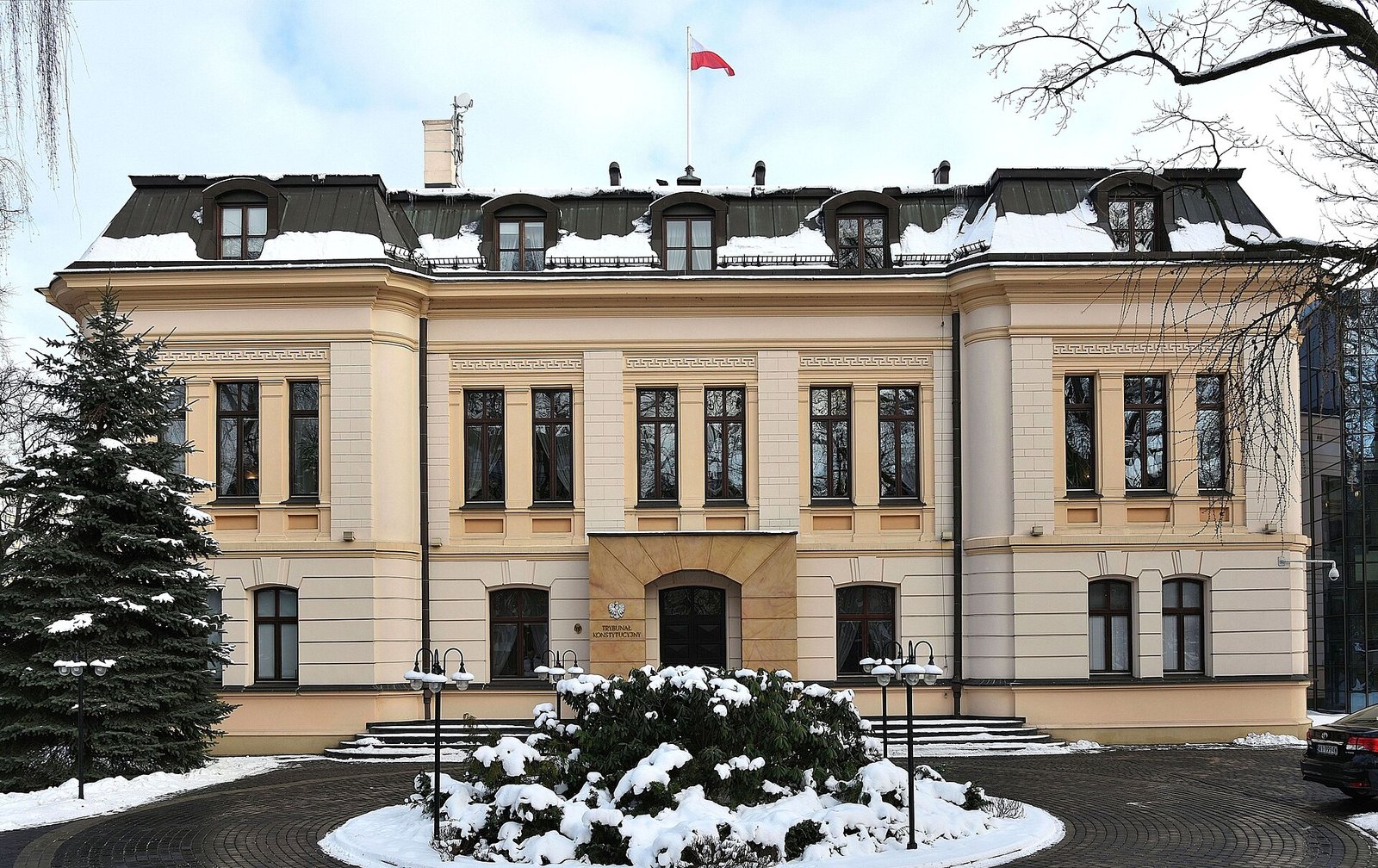
Photo: Adrian Grycuk / Wikimedia Commons, CC BY-SA 3.0 pl
Poland’s political standoff over its highest constitutional court sharpened over the weekend, as President Karol Nawrocki held emergency consultations with party leaders in Warsaw on Saturday (October 31) and Prime Minister Donald Tusk accused his nationalist opponents of trying to tear down the country’s democratic order. The talks at the presidential palace ended without any breakthrough.
A suspension late on Friday night
The crisis erupted late on Friday, October 30, when the Constitutional Tribunal announced that its longest-serving judge, Anna Korwin-Piotrowska, had suspended the court’s president, Bogdan Swieczkowski, and taken charge of the institution herself. Swieczkowski, a former deputy justice minister, was appointed during the 2015-2023 rule of the right-wing Law and Justice party (PiS). He had been accused of using his position to stop judges elected by the current parliament from taking their seats.
Nawrocki, a PiS ally who was abroad at the time, turned his plane around mid-flight on a trip to Africa and went straight to the court, where riot police had been deployed and several hundred protesters were demanding Swieczkowski’s reinstatement. In a statement read out by an aide early on Saturday, the president described what had happened as a breach of public order and a forcible takeover of a constitutional body. The tribunal’s own official X account called the government’s move a “coup d’etat”.
Talks without the ruling party
Nawrocki said he had called the urgent consultations because of a threat to Poland’s internal security. Nationalist and far-right parties, along with some members of the governing coalition, attended. Tusk’s centrist Civic Coalition stayed away.
Tusk has defended the removal as a painful but necessary step towards restoring the rule of law. In an evening address on Saturday, he went further, saying that for years there had been organisations and politicians in Poland who wanted to destroy democracy and the rule of law. PiS supporters continued weeks-long protests outside the court in support of judges seen as friendly to the party.
This process is difficult, at times even painful, and requires decisive action. There is no other way.
Donald Tusk, Prime Minister of Poland, on X
A dispute that dates back to 2015
The fight over the tribunal began in 2015, when the PiS government moved to appoint judges to seats that had already been filled by the outgoing administration. Its nominees went on to form a majority on the court, and critics in Poland and across Europe argued that the body no longer met the standard of an independent tribunal. The European Union accused PiS of undermining the rule of law, and one of the main complaints from Tusk’s camp is that PiS-aligned judges often ruled that Polish law took precedence over EU law.
Since Tusk’s coalition came to power in 2023 promising to reform the court, the two sides have refused to recognise each other’s appointees, leaving the tribunal largely paralysed. Earlier this year Nawrocki declined to swear in three of six judges chosen by parliament, while Swieczkowski refused to seat judges elected by the ruling majority. Last month parliament appointed Tusk ally Maciej Berek to the court, a move critics said cut against the government’s promise to restore checks and balances.
What happens next
Neither side shows signs of backing down. The European Commission on Saturday urged Nawrocki to accept the new judges at the centre of the dispute, according to international news agency reports, while US Ambassador to Poland Tom Rose appealed for calm, warning that the country did not need a confrontation that could spiral into something far worse. With Poland heading towards a parliamentary election in 2027, the standoff between the president and the government is likely to shape the campaign.