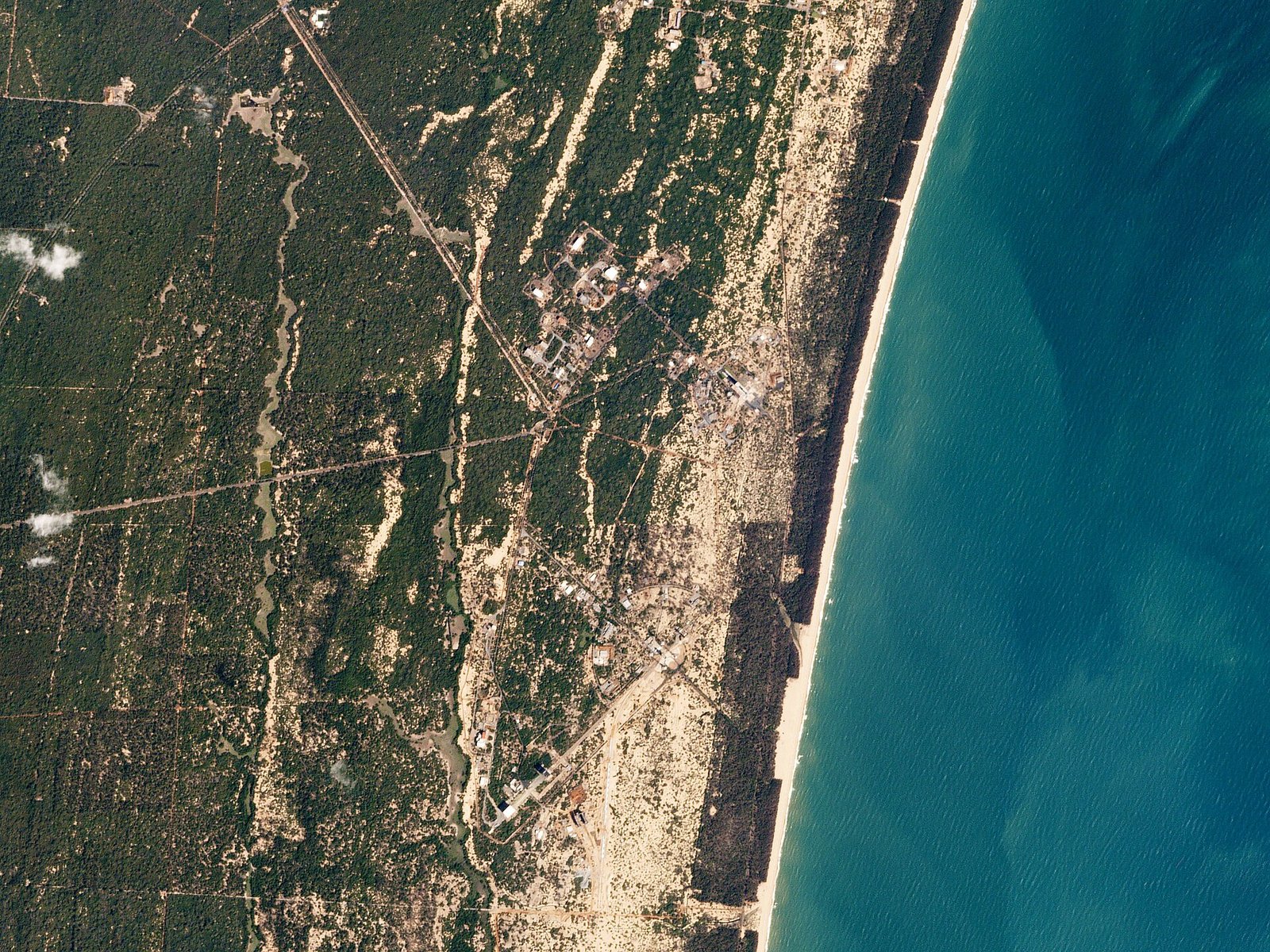
Photo: Planet Labs, Inc. / Wikimedia Commons, CC BY-SA 4.0
The Indian Space Research Organisation (ISRO) has placed its navigation satellite NVS-03 in orbit, launching it on a GSLV rocket from the Satish Dhawan Space Centre in Sriharikota at 11.51 pm on Friday, October 30. About 18 minutes after lift-off, the GSLV-F18 released the 2,250-kg satellite into a geosynchronous transfer orbit, and ISRO declared the mission a success shortly after midnight.
The satellite is the third in ISRO’s second-generation NVS series, built to keep NavIC, India’s home-grown alternative to the American GPS, running.
Why this launch mattered
NavIC needs at least four working satellites to deliver its core positioning, navigation and timing services. According to information shared by the government, only three of the 11 satellites launched for the constellation have been able to do their main job: the first-generation IRNSS-1B and IRNSS-1I, and the second-generation NVS-01.
Even those are not secure. IRNSS-1B has already outlived its designed 10-year life, and IRNSS-1I is expected to last only until about 2028. NVS-02, launched in January 2025, never reached its working orbit because its onboard engines failed to fire. Once NVS-03 completes its orbit-raising and checks, it is expected to bring the network back to the four-satellite minimum.
What NVS-03 carries
ISRO says the satellite carries an indigenous atomic clock along with imported ones, a key part of any navigation system since positions are worked out from precise timing signals. It adds the L1 signal, the frequency widely used by consumer devices, to the existing L5 and S-band signals. NavIC covers India and a region extending about 1,500 km beyond its borders, and is used for tasks such as real-time tracking of trains, vehicles and ships.
Prime Minister Narendra Modi congratulated ISRO’s scientists and engineers on Saturday, calling the mission an important step in strengthening NavIC and in India’s push for self-reliance in critical technologies.
This mission marks an important step in strengthening NavIC, our indigenous satellite navigation system.
Prime Minister Narendra Modi, in a post on X
A slow road back
The NVS programme has moved slowly. NVS-01 went up in May 2023 and NVS-02 in January 2025, with NVS-03 following about 20 months later. ISRO also had a difficult stretch, with three failures in six launches from Indian soil between January 2025 and January 2026. Friday’s flight was the 20th for the GSLV and ISRO’s third launch of the year.
What happens next
The satellite will now raise itself from its transfer orbit to its final position and go through commissioning before it can start serving users. Four satellites only meet the bare minimum, so ISRO will need to launch NVS-04 and NVS-05 to replace the ageing first-generation craft, and a sturdier network with spare satellites would need around six to seven NVS-series satellites in orbit.