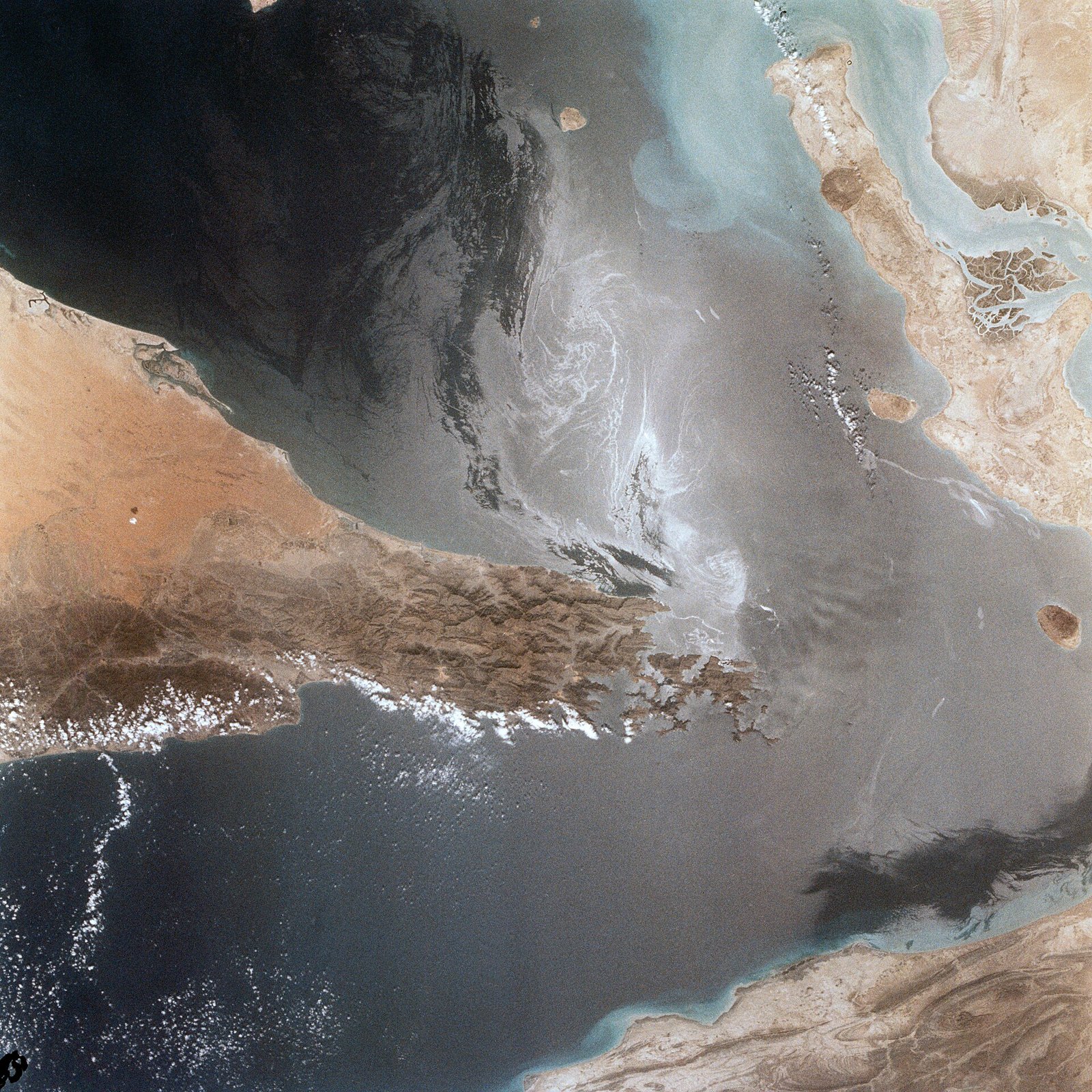
Photo: NASA / Wikimedia Commons, public domain
A Panama-flagged crude oil tanker with 27 Indian seafarers on board was crippled by explosives fixed to its hull in the Strait of Hormuz, in what maritime security sources describe as the first successful limpet-mine attack in the waterway since the war between the United States and Iran began in February. Union shipping minister Sarbananda Sonowal said on Friday that every Indian crew member was safe.
What happened to MT Louise 1
According to the United Kingdom Maritime Trade Operations (UKMTO), the British naval agency that tracks incidents in the region, a small boat came alongside an outbound tanker late on October 29 (early October 30, Indian time) and attached two explosive devices to its hull above the waterline. The blasts started a fire in the engine room and briefly disabled the ship about 25 nautical miles (46 km) northeast of Khasab, Oman. The crew put the fire out, no one was hurt, no pollution was reported, and the vessel carried on towards its next port.
UKMTO did not name the ship, but maritime security sources identified it as MT Louise 1. The same sources said an attempt to use limpet mines in September had failed because the devices did not go off. Who carried out the attack has not been established.
All 29 Indian seafarers across both vessels are completely safe with no injuries.
Sarbananda Sonowal, Union minister for ports, shipping and waterways
Sonowal said a second ship, the Liberia-flagged supertanker MT Arzanah with two Indians on board, had been targeted in a separate projectile attack on October 29. He said the ministry was monitoring both cases and working with the ship management companies on the crews’ security.
Rival claims over mines
Iran’s Revolutionary Guards Navy said on Friday that three oil tankers had caught fire or exploded while using what it called unauthorised routes through the strait, and that one of them, carrying more than 2 million barrels of crude, had hit a naval mine. The day before, the Guards had said three tankers struck mines on the strait’s southern route, and Iran’s regular army reported a fourth vessel on fire east of the waterway. It is not clear how many of these ships overlap, and none of the claims has been independently verified.
Oman’s Maritime Security Centre said the Royal Navy of Oman evacuated all 25 crew members from the Panama-flagged merchant ship RITI after it was attacked and caught fire about 1.6 nautical miles off the Musandam coast. The crew received medical care.
US Central Command maintains that the main shipping lanes have been cleared of Iranian mines, and earlier in the week called Iran’s mine-strike reports false. Guards spokesman Hossein Mohebi challenged Washington to back that up with “independent evidence, not a statement”. Central Command also rejected Iran’s claim to have destroyed an American unmanned surface vessel, saying all of its sea drones in the region were accounted for.
Why it matters
Roughly a fifth of the world’s oil supplies normally pass through the strait, and traffic has fallen to a handful of ships a day since the war began. Tehran wants vessels to coordinate with it and sail closer to its northern shore, while ships trying to avoid Iranian control have used the southern route.
What comes next
The attacks come as Qatari mediators returned to Tehran on Friday with a revised proposal, while reports from Washington say the US and Israel are weighing fresh strikes on Iran after the November 3 US midterm elections. President Donald Trump said on Friday the war would end “soon”, without saying whether through a deal or military action.