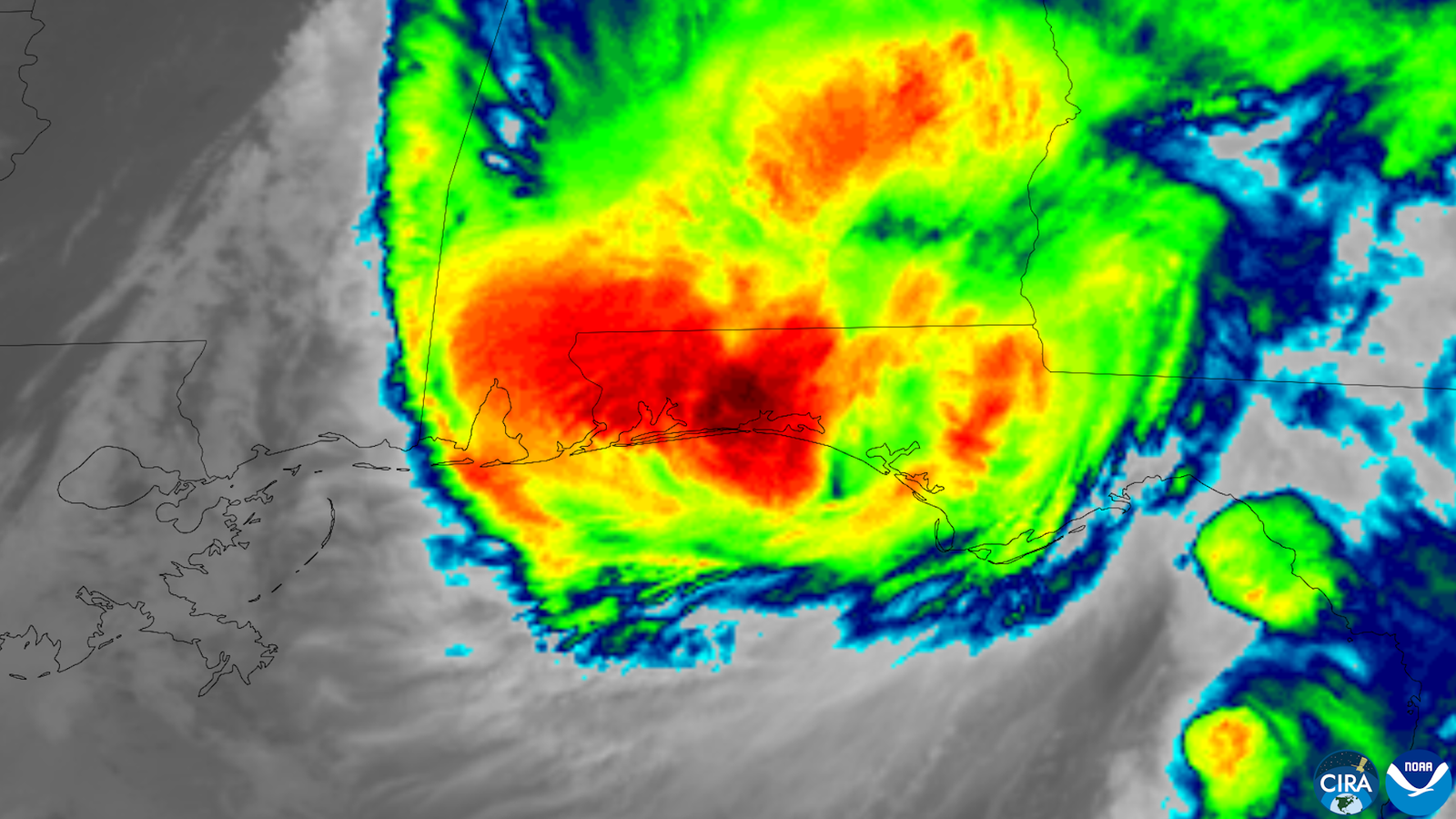
Photo: GOES imagery: CSU/CIRA & NOAA / Wikimedia Commons, public domain
At least four people have died in the southern United States after Hurricane Isaias came ashore on Florida’s Gulf Coast, and more than 5 lakh homes and businesses were still without electricity on Saturday night across Florida, Alabama and Georgia, according to officials and an online outage tracker.
The storm made landfall late on Friday near the resort town of Destin as a Category 2 hurricane, with maximum sustained winds of about 168 km/h (105 mph), the US National Hurricane Center said. It weakened steadily overnight and has since been downgraded to a post-tropical cyclone, but forecasters warn that its heavy rain remains a serious danger.
Deaths in Florida and Alabama
Officials in each of the two states reported two deaths. In Florida’s Escambia County, around Pensacola, Sheriff Chip Simmons said a woman was killed when a tree crashed through her house. He later said a man had died of carbon monoxide poisoning after running a generator inside a garage that was not properly ventilated, and that four other people from the same house were taken to hospital.
Alabama Governor Kay Ivey said two residents of her state had lost their lives, without giving details. Reports from Alabama said one of the deaths was caused by a tree falling on a home in Birmingham. A sheriff in the state was also hurt when a tree came down on him while he was attending to a road accident.
Rescue crews pulled people from cars trapped in floodwater. The Florida National Guard said its soldiers stopped on the road, swam out to a vehicle stuck in a flooded ditch and brought the people inside to safety.
Downed power lines, standing water, any of that can be very, very hazardous. Don’t run any generators inside your home or inside your garage.
Ron DeSantis, Governor of Florida
Why this storm stands out
Isaias is the first hurricane of this year’s Atlantic season and the first to strike the US mainland since 2024. Meteorologists say the season has been unusually quiet because of an exceptionally strong El Niño, which creates powerful winds high in the atmosphere over the Atlantic that tend to rip developing storms apart. The same pattern has the opposite effect in the Pacific, where several powerful hurricanes have already formed this year.
Alabama, Florida and Georgia declared states of emergency before the storm arrived, and Florida and Alabama ordered thousands of people to evacuate. Because the Gulf Coast is the country’s main oil-refining region, the US Department of Energy on Saturday cleared the release of up to four million barrels of crude from its emergency reserve to limit any supply disruption.
What happens next
As the remnants of Isaias move north-east and inland, federal forecasters say parts of Georgia and the Carolinas could get as much as 25 cm (10 inches) of rain. The National Hurricane Center has warned of possible flash floods and landslides in the southern Appalachian mountains, a particular worry in western North Carolina, where communities are still rebuilding after deadly flooding from Hurricane Helene in 2024.
Coastal South Carolina is also on alert. The city of Charleston asked people to stay indoors on Saturday night, with a high tide of about 2.3 metres expected, and warned that floodwater is much harder to judge after dark. Governor Ivey said officials were also watching for tornadoes spun off by the storm.
On the other side of the continent, Hurricane Simon, a Category 4 storm, is approaching Mexico’s Pacific coast, while Tropical Storm Rachel is forecast to reach Mexico’s Baja California and southern California.